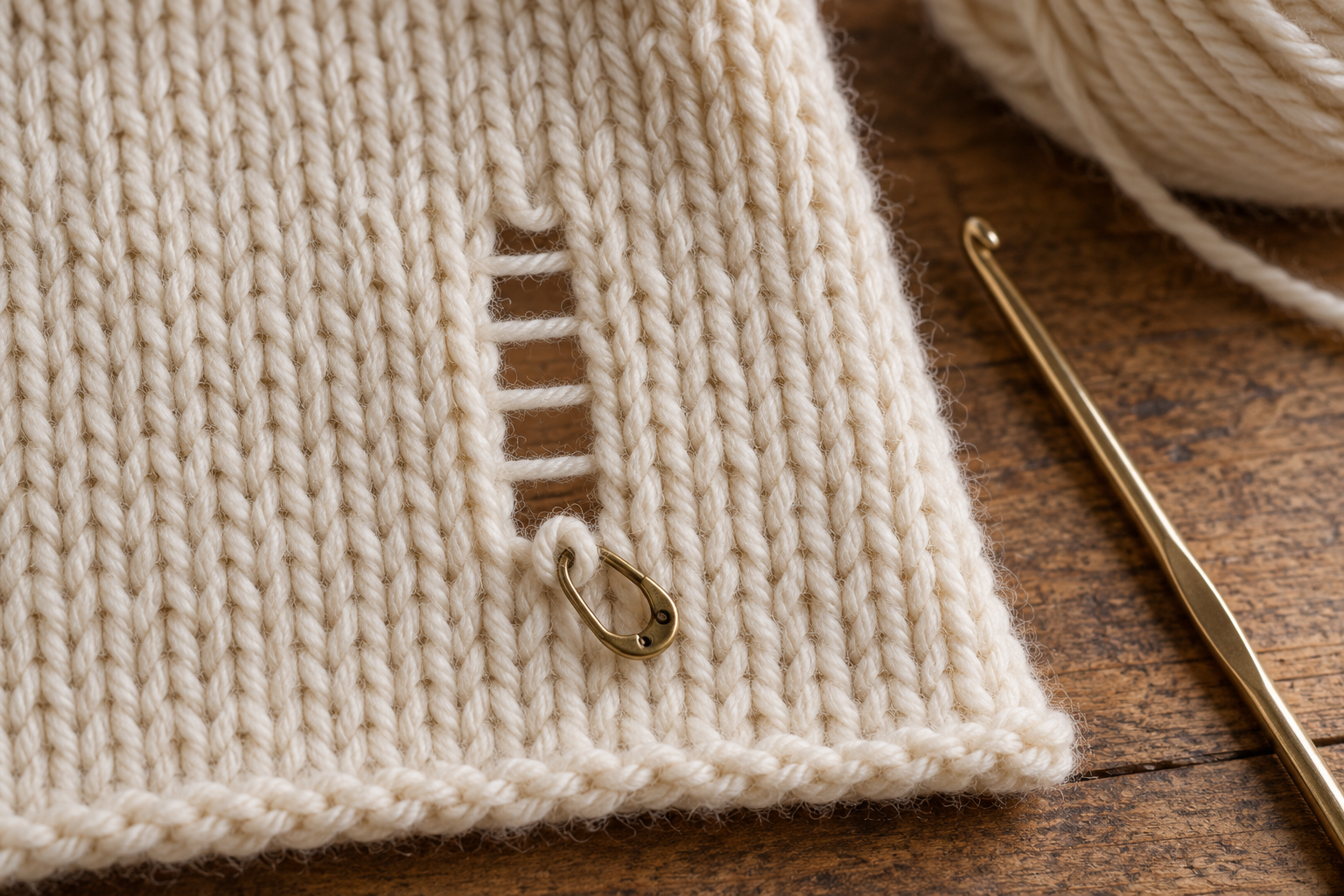
A dropped stitch looks like a hole with a ladder in it. The important part is the small loop at the foot of that ladder. It has slipped free of the needle and, as successive stitches unmake themselves, the yarn that held them becomes a set of horizontal bars. The yarn has not vanished. The structure has come undone in one column.
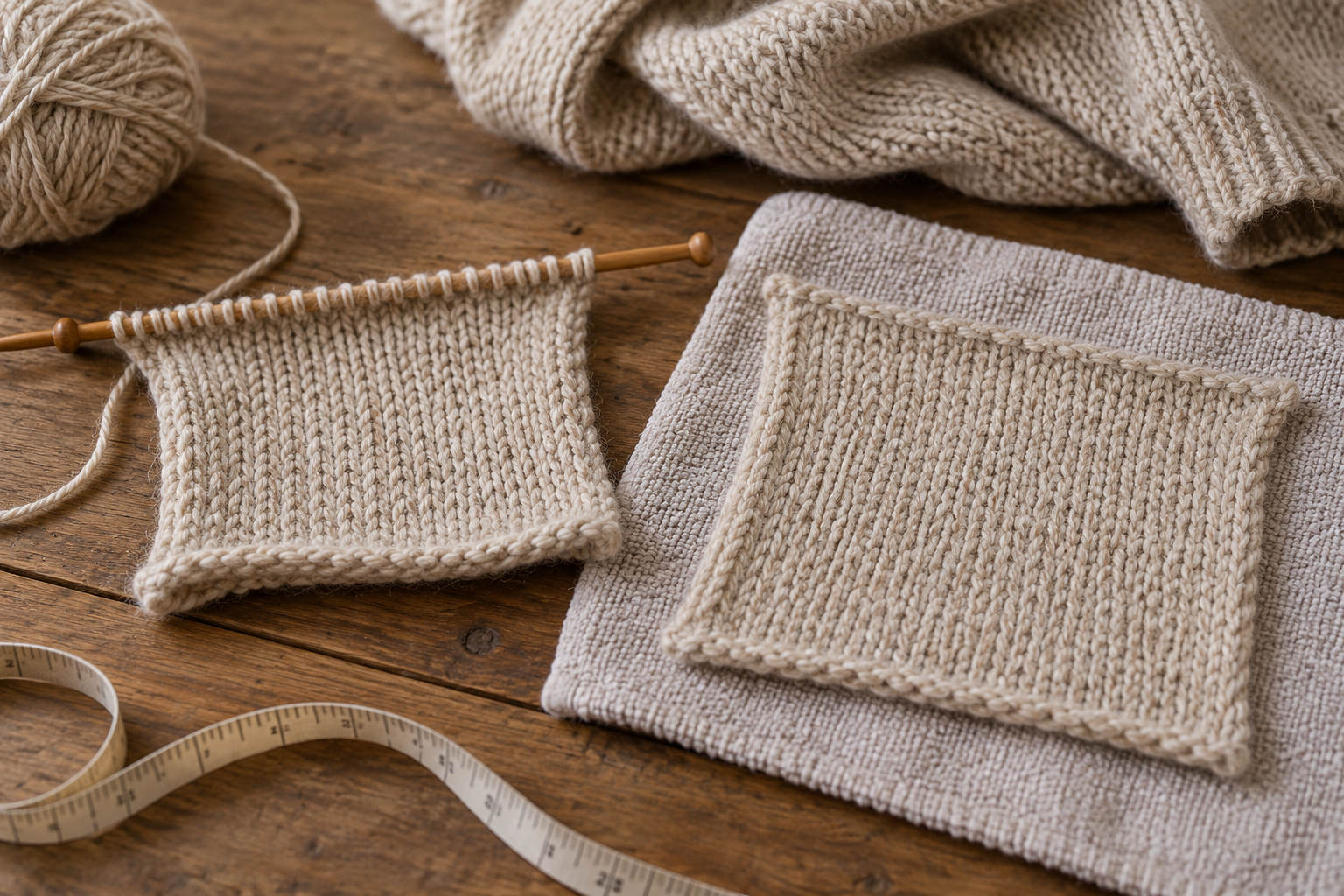
This is why the sight can be alarming and the repair, in a plain fabric, surprisingly local. Each bar can be drawn through the loop below it to rebuild a stitch. The method follows the path the yarn took in the first place. Brooklyn Tweed's guide to reading knitting describes the fabric as linked loops arranged in rows and columns: knit faces show stacked Vs, while purl faces show raised horizontal bumps. A dropped column interrupts that visible sequence. Before reaching for a hook, read the fabric around it. The neighboring stitches show what the missing ones need to become.
First, keep the loop from travelling
If the loose loop is still near the needles, place it back on a needle or catch it on a locking stitch marker. If it has run down several rows, secure the lowest intact loop before tugging the fabric or setting the work aside. Interweave's illustrated guide to fixing knitting mistakes recommends locking markers among the tools for holding dropped stitches; its diagrams distinguish the hanging loop from the bars above it. The marker is a pause button, not a repair. It preserves the place where the knitting is still sound.
Trace the missing column upward and count its bars. In stockinette, the V columns on either side make the route relatively clear. Then look at the live stitches at the top. Knit Picks' dropped-stitch tutorial points out a less obvious complication: if knitting has continued above the drop, neighboring stitches can close the space into which the rescued column would normally return. A hook may reconstruct the lower loops, but the top may require unknitting enough of the current work to reopen the column and put the final loop back on the needle. The number of rows that can be repaired neatly from below is not a fixed distance; it depends on what was knitted over the missing stitch.
This initial look also prevents a mistaken diagnosis. A loose vertical gap between double-pointed needles can be a tension ladder with all stitches still present. Interweave describes those gaps as an issue at needle changes, distinct from a dropped loop. An intentional eyelet or yarn-over has a different place in the pattern. Count the live stitches and find the loop at the bottom before treating every visible opening as a dropped stitch.
Rebuild the plain column one bar at a time
For a knit-facing column, put a crochet hook through the secured loop from the front of the fabric. Catch the lowest horizontal bar above it and draw that bar through the loop, frontward, forming a new loop on the hook. Repeat with the next bar, always working from the bottom upward. The Craft Yarn Council's Knit 911 instructions and Interweave's repair diagrams set out this same sequence. Skipping a bar leaves one row unreconstructed; taking a higher bar first tangles the order. The hook holds just the newest loop as each earlier loop becomes part of the fabric again.
Turn the work if the wrong side gives a clearer view. To reconstruct a purl-facing stitch from that face, the hook enters from back to front and draws the bar toward the back; Interweave notes that some knitters find it easier to turn the piece and work that same stitch as a knit from the other face. This is not an arbitrary reversal. A knit V on one side is a purl bump on the other. The direction in which the bar passes through the loop determines which face appears when the repair is laid flat.
When the final bar has been worked, return the loop to the needle at the correct position. Check how its legs sit before knitting it. A loop put back backward can be twisted on the next row, leaving a tight crossed V where the rest of the column is open. The Craft Yarn Council's Knit 911 guidance on twisted stitches describes reversing a backward-mounted stitch before working it. Look at the neighboring live loops for a local model rather than forcing a rule onto a knitting style whose stitch mount differs.
A ridge changes the route
Garter stitch makes the same dropped column less obvious. Although a flat garter fabric may have been made by knitting every row, its visible face alternates knit valleys and purl ridges. If every loose bar is pulled through in the knit direction, the repair makes a smooth stockinette streak across those ridges. Interweave's guide instructs a garter repair to alternate the knit and purl reconstruction from row to row. In an original 2010 demonstration, knitting teacher Staci Perry likewise explains that the ladder has to pass through the loop in alternating directions to preserve the garter pattern.
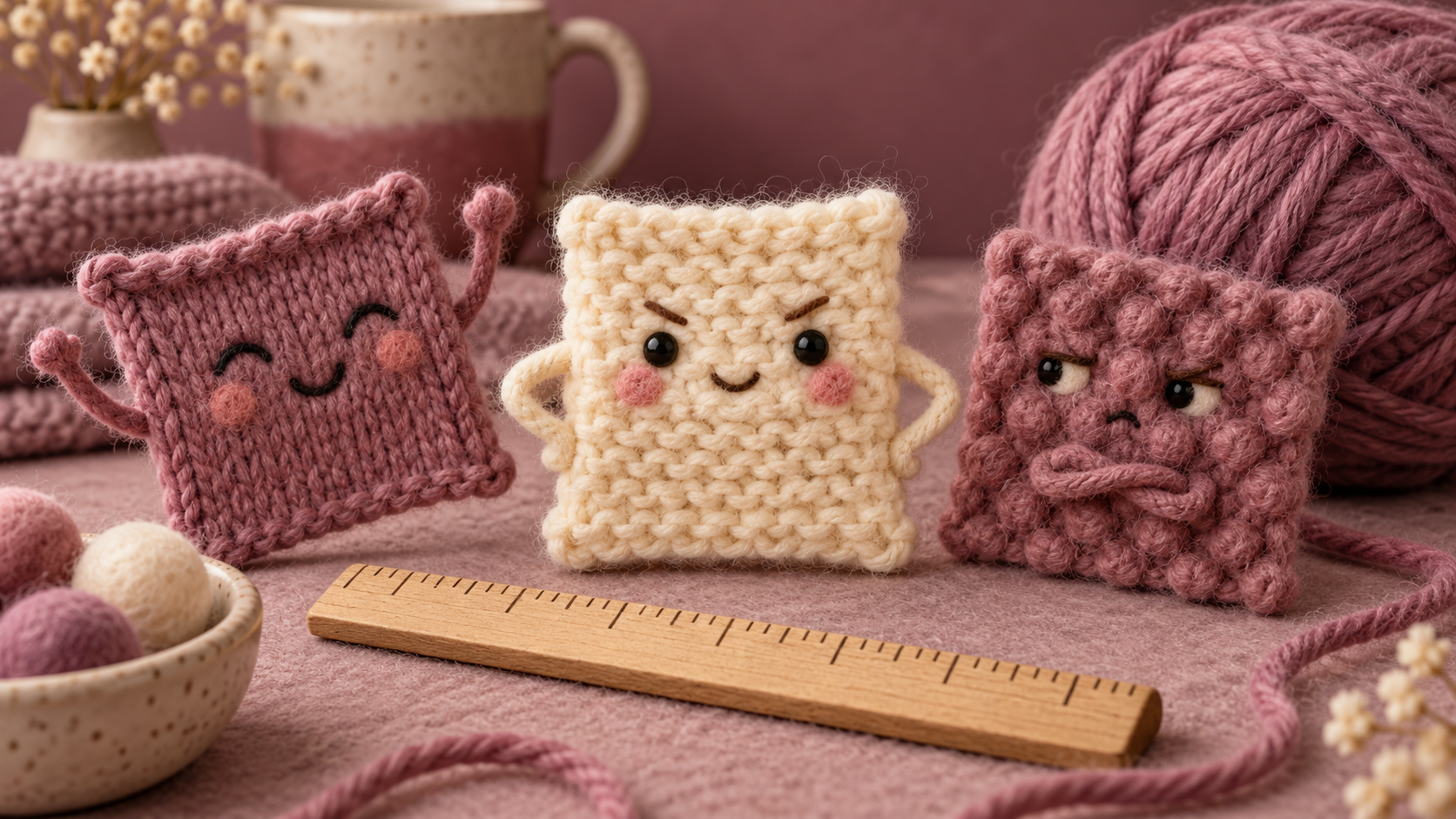
Pause after each recovered row and compare it with the adjacent columns. The bar you are working should become the same kind of surface stitch as the stitches beside it at that height. This is easier than memorizing a long sequence of front and back movements while the work is turned around. Knit Picks' tutorial suggests practicing the knit, purl and garter versions on a small swatch. A practice square allows a deliberate drop and a visible comparison without the weight of a nearly finished sleeve attached to the experiment.
Edges call for another reading of the yarn. An interior dropped stitch leaves bars between the neighboring columns; a dropped edge stitch may leave one large loose loop at the side instead. Interweave's edge-stitch diagrams show how the upper and lower parts of that edge loop can be used in turn to rebuild the edge. Trying to hook imaginary horizontal bars across the gap would miss what the yarn actually did. Look for the length of yarn that is loose, then follow it back through the fabric's original path.
Where a single hook stops being simple
In lace, cables, brioche or shaped fabric, a column may contain more than one plain loop per row. A decrease joins columns; a yarn-over adds a loop; a cable crossing sends the stitches sideways. Brooklyn Tweed's explanation of increases and decreases shows the columns branching and converging rather than remaining in one vertical lane. A hook drawn straight upward can restore the stitch count while placing the stitch on the wrong side of a decrease or erasing a texture. In such fabric, compare the relevant chart or repeat and decide whether to rework several involved stitches, unknit a few rows, or secure the stitches and rip back to a stable point.
For a mis-crossed cable, Interweave describes catching the involved stitches below the error, laddering those stitches down, then reworking the crossing with the loose yarn. It also describes a lifeline threaded through a sound row to make ripping back less uncertain. These are different scales of repair, chosen by the structure that needs rebuilding. A strand that runs through several stitches cannot necessarily be restored by treating each as an independent stockinette column.
Nor is a dropped stitch always a mistake. Jared Flood's Halus hat pattern, published in the Winter 2016 collection, deliberately drops three prepared knit columns and chains the resulting bars back into a raised design. The accompanying Brooklyn Tweed tutorial starts by securing the base loops with a marker. It is a useful demonstration of the same underlying logic: loops can be released because the knitter knows where they must stop and how their yarn will be worked afterward. It is not a method to copy onto an accidental one-stitch ladder; the grouped bars and intended chain are specific to that design.
After a plain repair, the rescued column may look tight or uneven beside its neighbors. Ease a little yarn along adjacent stitches with a blunt needle or fingertip rather than pulling hard on the new loop. Interweave recommends redistributing tension after its more complex cable repair for the same reason: the yarn has been put back into its path, but it may not yet be shared evenly. Inspect the right and wrong faces, count the live stitches, and confirm the pattern before knitting onward.
The ladder is a map of an interrupted process. Its bottom loop tells where the unravelling stopped; its bars retain the yarn for the missing rows; the neighboring fabric tells which way each bar should pass. Once those three things are visible, repair becomes less a rescue trick than a way of reading what the knitted fabric is made of.

A thought worth keeping?