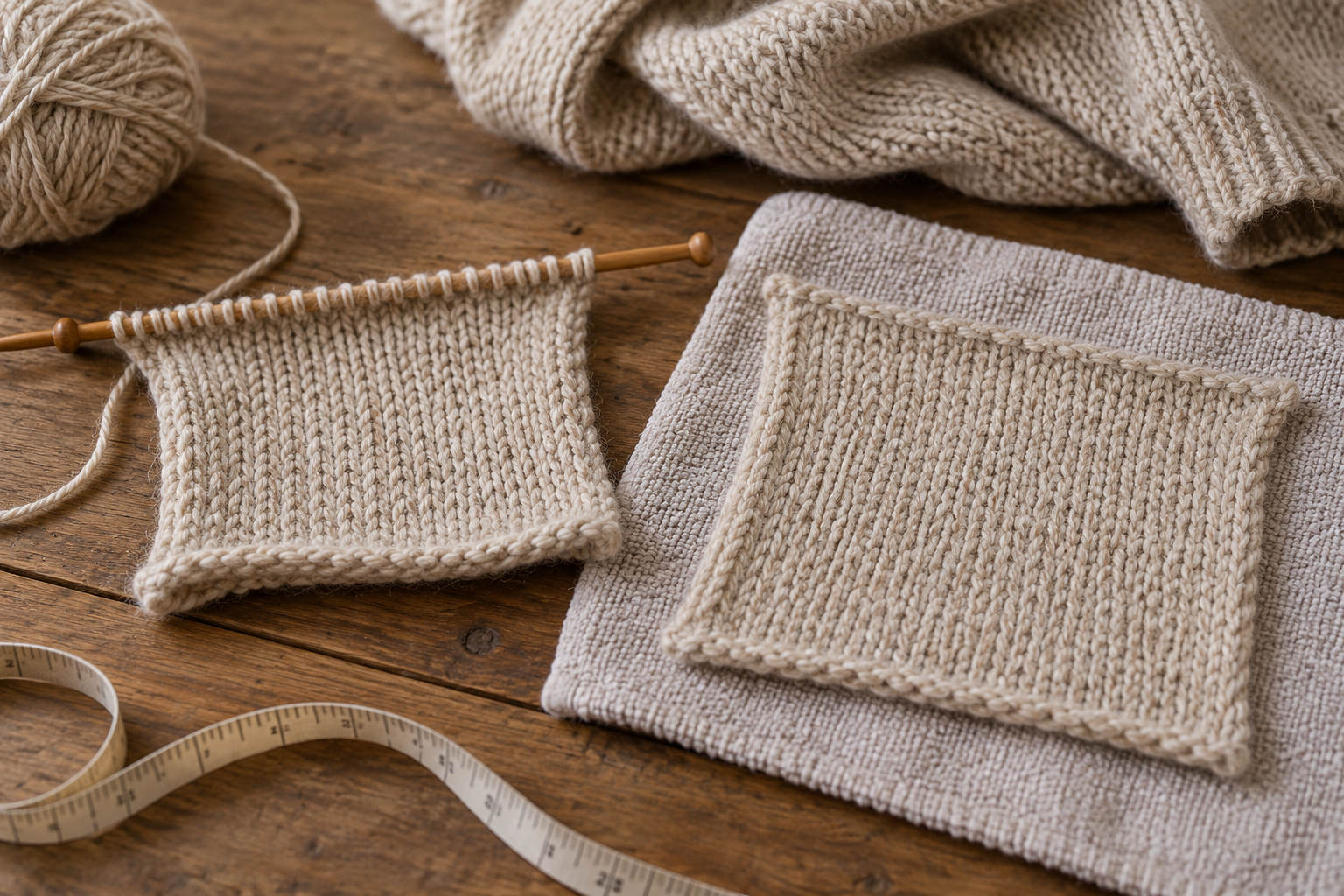
A sweater can grow wider and become shorter in the same wash. That sounds contradictory until the fabric is measured in two directions. In a Knit Picks account of swatching its Simply Cotton Sport yarn, one sample made on US 3 needles measured 6.5 stitches and 7.75 rows per inch before laundering. After a cold machine wash and machine dry, it measured 6.25 stitches and 8.75 rows per inch. Fewer stitches fit across an inch, so the fabric had widened. More rows fit into an inch, so it had shortened. Those are observations about one yarn, one swatch and one care method, not a forecast for every cotton sweater. They show why an unwashed swatch may answer the wrong question.
The question is not simply, “Can I knit the number printed in the pattern?” It is, “What size and kind of fabric will these stitches make when the sweater has been cared for as the finished sweater will be?” The little square cannot guarantee the whole garment's behavior. It can reveal a difference early enough to make a decision while the work is still small.
A count becomes a circumference
Gauge is a count of stitches and rows within a measured span. The Craft Yarn Council's pattern standards call for both counts, taken in the stitch pattern used for the project, because the pattern's dimensions depend on them. A needle size in the instructions is a starting point; the resulting fabric is the evidence. Two knitters can use the same needle and still make different loops, and one knitter can knit differently in stockinette, ribbing or a textured pattern.
Width makes the stakes easy to see. Suppose a sweater has 200 stitches around a plain section. At an intended gauge of 20 stitches in four inches, or five per inch, that round measures 40 inches. If the washed fabric measures 19 stitches in four inches, the same 200 stitches make about 42.1 inches. The extra 2.1 inches are arithmetic, not a typical amount of growth. A quarter stitch per inch looks small on a ruler; carried through 200 stitches, it changes the fit. Depending on the intended ease, that change may be welcome or may turn a carefully chosen size into a different one.
Rows matter too, though their effects are less uniform. In a straight body that is knitted until it reaches a specified length, the knitter can often stop at the ruler rather than at a fixed row count. A shaped yoke, armhole, sleeve cap or repeated motif may place increases and decreases on particular rows. A different washed row gauge then changes where those events fall in the finished fabric. The Simply Cotton example is particularly instructive because its stitch and row gauges moved in opposite directions. Checking only width would have missed half the change.
The wash is part of the measurement
Freshly knitted loops hold some of the arrangement imposed by needles, hands and the weight of the work. Water, agitation, heat and drying can let that arrangement settle or alter it. The fiber, yarn construction, stitch pattern and treatment all matter. There is no sound general rule that wool always grows, cotton always shrinks or a blocked sweater always keeps precisely the dimensions it had while pinned.
“Blocking” is also more than one action. Knit Picks' sweater-blocking guide describes wet, spray and steam methods, and recommends trying a method on a swatch while following the yarn's care instructions. A light spray and a careful flat dry do not put a fabric through the same treatment as a machine wash and tumble dry. If the sweater will be washed at home, the useful gauge is usually the gauge of a swatch that has undergone the care the sweater will actually receive, measured after it is fully dry. If a pattern explicitly defines gauge before blocking or after a particular finishing method, follow that definition and compare like with like.
The drying step can be as consequential as the wash. Woolmark's Merino sweater-care guide says to consult the garment's care label and dry wool sweaters flat where instructed; a wet sweater hung from its shoulders can stretch under the weight of its water. That is a reason to treat a hanging wet swatch and a flat-dried garment as different experiments. The guide also distinguishes care treatments among wool garments. “Wool” alone does not tell a knitter whether machine washing or tumble drying is permitted.
Nor does “machine washable” mean “dimensionally fixed.” Knit Picks' discussion of easy-care yarns explains that superwash treatment helps wool resist felting and recommends comparing a swatch before and after laundering. It also cautions that direct heat can damage acrylic yarns. A treatment that changes one risk does not erase the need to check the fabric's size, surface and feel after care. The label specifies a permitted process; a swatch shows what that process does to this particular combination of yarn, stitches and hands.
Make a sample that can answer the question
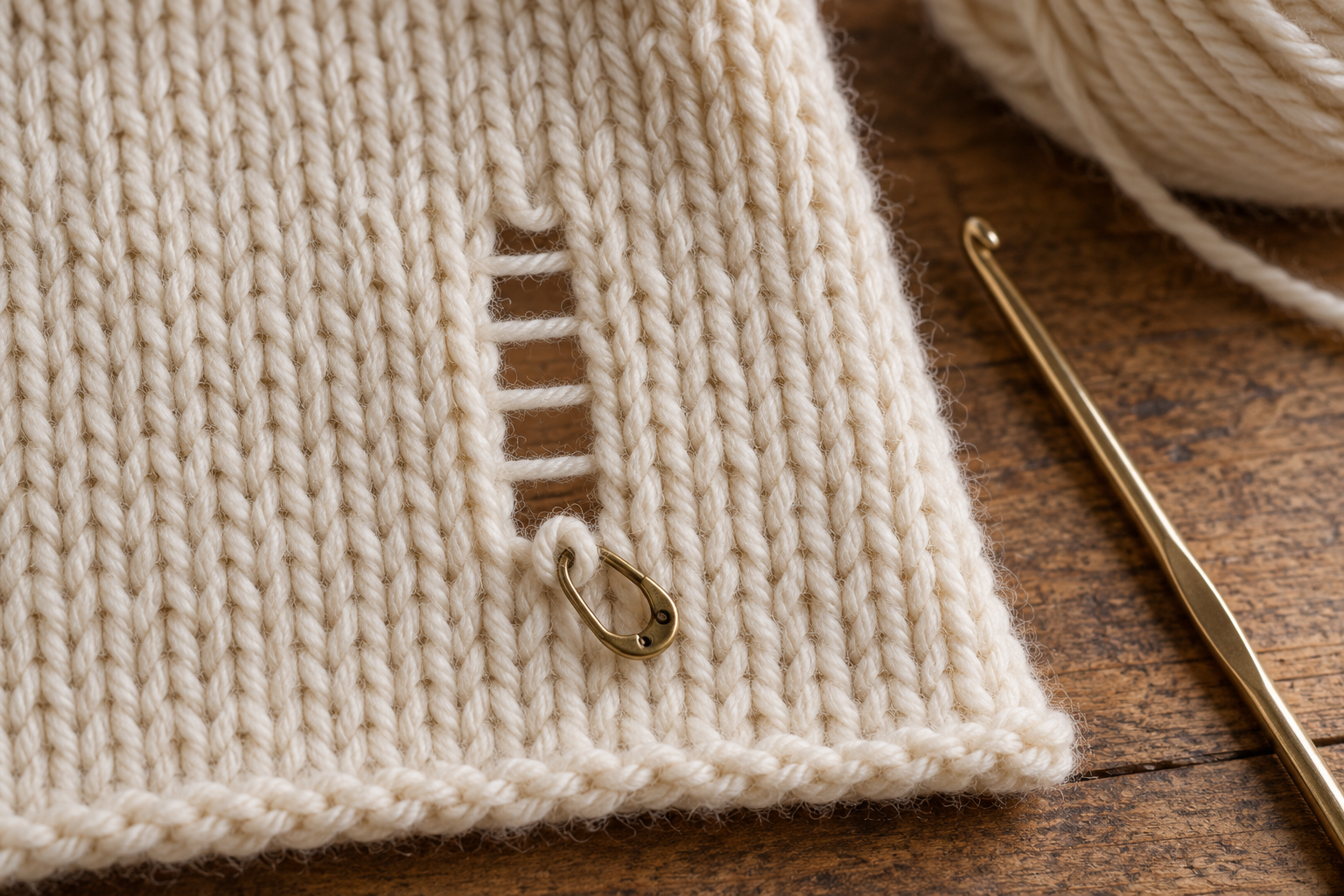
A four-inch square made edge to edge is awkward to measure: its cast-on, bind-off and side edges can pull or curl. Knit Picks' swatching guide suggests making a sample about six inches wide and five inches long, then measuring a central four-inch span and counting fractional stitches and rows. The Craft Yarn Council's standard sets four inches as a minimum sample size, with a larger sample when the pattern calls for it. These are useful scales, not a promise that every yarn behaves identically at a given swatch size. A bulky cable or broad colorwork repeat may need much more room to show its ordinary fabric.
Use the proposed yarn, the proposed needle material and size, and the stitch pattern whose gauge governs the sweater. Work enough plain fabric around the measured area that the ruler can stay away from the edges. If the garment is worked in the round, make a circular sample when the difference between flat and circular knitting could matter: purling back across a flat sample may not reproduce the all-knit rounds of the garment. Keep a note of the needle and the initial stitch and row counts. The first count is useful even if the final one is the deciding measurement, because it tells you which direction the fabric changed.
Then care for the sample as the finished sweater will be cared for, within the yarn label's instructions. Do not stretch it into the hoped-for size while it dries unless the pattern deliberately calls for that kind of shaping. Let it dry fully and rest before measuring the center again. Lay the ruler over several inches of ordinary fabric, not a curled corner or a single unusually tight column. Count both axes. Look at more than the numbers: a fabric that reaches gauge only by being pulled open may be too sheer, limp or distorted for the sweater in the photograph. A swatch is an audition for the fabric as well as a calculation of its size.
What to change when the numbers disagree
If the washed stitch gauge is too loose for the pattern, a smaller needle often makes smaller stitches; if it is too tight, a larger one often makes larger stitches. But a new needle requires a new washed swatch. Changing stitch gauge can change row gauge and the hand of the fabric as well. At some point a different yarn or a different size may give a better sweater than forcing the proposed yarn to meet a number at the cost of its drape. The pattern's finished measurements and the wearer's desired ease belong in that decision.
If stitch gauge matches but row gauge does not, resist the urge to declare the whole project safe. Straight sections can often be worked to length, while row-based shaping and repeats need closer attention. An experienced knitter may adjust the spacing of shaping without changing its total count; a beginner may be better served by choosing a yarn whose washed row gauge is closer, or a pattern with simpler shaping. The exact remedy depends on the construction. There is no universal correction of “add two rows every few inches.”
Blocking can neaten stitches and bring a garment toward intended dimensions. It cannot make any yarn, at any gauge, permanently behave like the pattern's sample. Even a careful square cannot reproduce the full weight of a sweater, the strain at its shoulders or every later wash. Check the growing garment against the pattern's measurements, and keep the swatch's washing notes for its first real laundering.
The washed swatch is small enough to seem expendable. Its value is that the mistake, if there is one, remains small too. It turns a guess about finished fabric into a measured choice: this yarn, on these needles, treated this way, makes a sweater of roughly this shape and size.
A thought worth keeping?