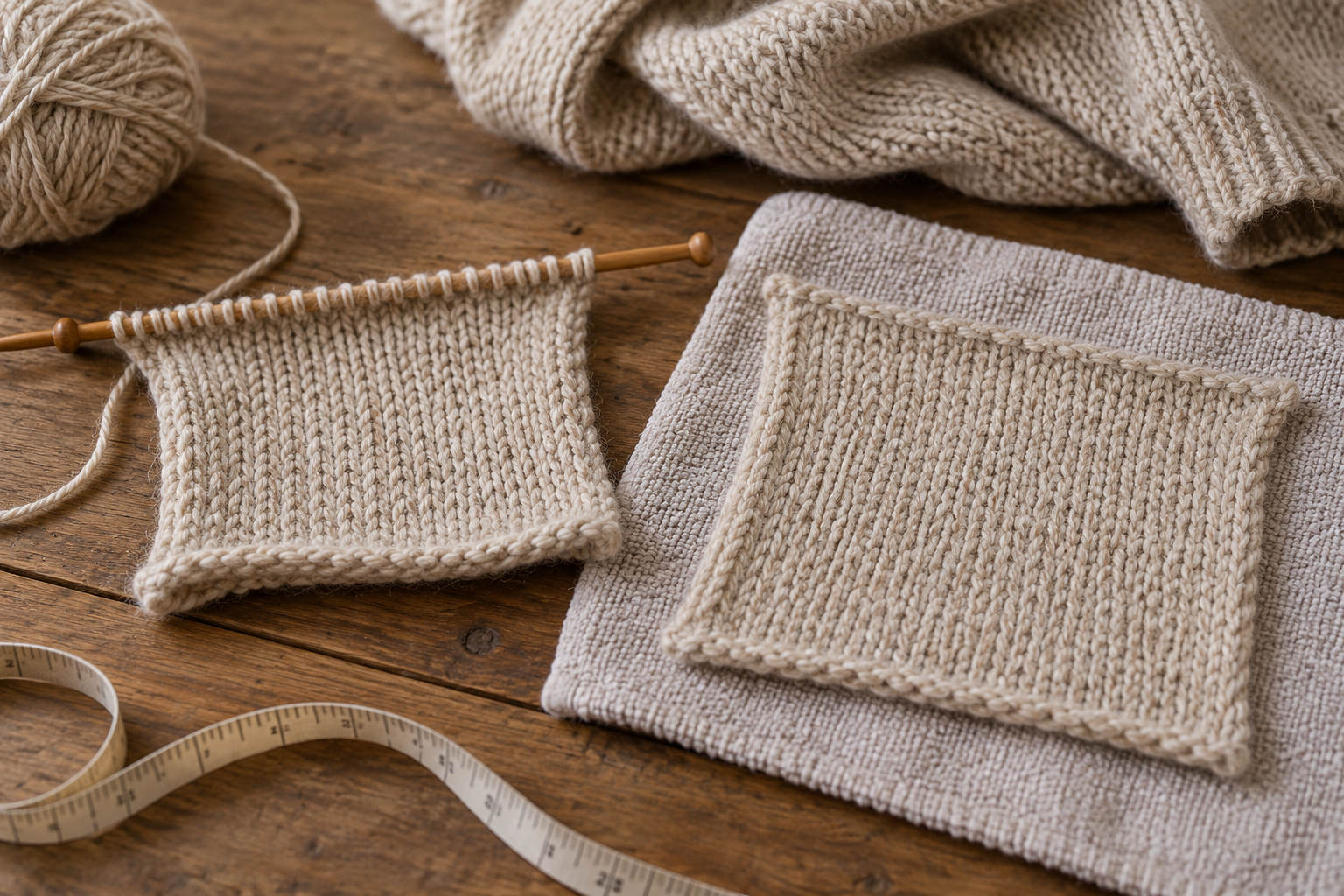
The swatch looked harmless. A small knitted square, a few measurements and no ambition to become the main event. Then I compared it with the confident plan and discovered that the confident plan had been making several optimistic assumptions.
I wanted a particular feel for the garment. The yarn and stitch arrangement produced something different when I handled the sample. It looked appealing, but the texture and behavior were not what I wanted against the shape I had imagined.
This was disappointing for about five minutes. Then it became an unusually efficient piece of information. A small square had raised a question before I invested evenings in an entire garment.
I recorded the yarn, needles and stitch arrangement, then handled and treated the sample in a way suited to the eventual project and the material's care guidance. The details matter because a swatch without its conditions becomes a tiny attractive mystery at the bottom of a bag.
I also wrote what I liked. An experiment can show an unsuitable choice for one project and a promising choice for another. The sample did not need to receive a single universal verdict.
The revised plan was less confident and more specific. I tried another small arrangement rather than adding increasingly persuasive adjectives to the first one.
I keep the samples together with their notes. Some belong to garments I finished. Some belong to ideas I changed. The collection is not a gallery of failure; it is evidence that a question can be asked while the answer is still pleasantly small.
The original little square remains rather charming. It has been excused from the job of becoming a jumper.
A thought worth keeping?